tag:bedalab.nd.edu,2005:/newstag:bedalab.nd.edu,2005:/latestBEDA Lab | News2026-01-29T16:06:00-05:00The Built Environment Decarbonization (BEDA) lab is at the forefront of multidisciplinary research, pioneering decarbonizing the built environment.tag:bedalab.nd.edu,2005:News/1788042026-01-29T16:06:00-05:002026-01-29T16:06:52-05:00School of Architecture’s Ming Hu Wins the 2026 AIA/ACSA Practice and Leadership Award
The American Institute of Architects (AIA) and the Association of Collegiate Schools of Architecture (ACSA) selected the project, From Studio to Systems: A Research-Based Model for Architectural Education, by Ming Hu, associate dean for research, scholarship and creative work in Notre Dame’s school of architecture, as the winner of the 2026 AIA/ACSA Practice and Leadership Award. This national award, which is jointly sponsored by the AIA and ACSA, honors exemplary models of teaching, scholarship, and outreach that demonstrate leadership and sustained impact on architectural education and professional practice.
The award emphasizes excellence in preparing students for real world practice and leadership.
“I’m sincerely grateful for this recognition and I see it very much as a reflection of the School’s broader commitment to research-informed pedagogy, experimentation and meaningful engagement with practice. The intellectual environment, encouragement and institutional support provided by the School have been essential in allowing this pedagogical work to take shape and ultimately be recognized at a national level” Hu said.
The project presents a reimagined model of architectural education that replaces traditional, form-driven studio pedagogy with interdisciplinary, research-based, and practice-engaged learning. Developed at the University of Notre Dame, this approach addresses critical gaps identified in the 2023 ACSA white paper, including the lack of standardized pedagogies and limited student exposure to real-world stakeholders and data-driven methods, according to the project description.
Guided by three central questions, the model introduces new course formats and collaborative frameworks. Architecture students are embedded within interdisciplinary teams alongside engineers, real estate professionals, and environmental scientists to solve sustainability challenges at both building and urban scales. Courses such as ARCH 43611: Carbon Neutral Development and SU25-34500: Real Estate and Sustainable Development emphasize real-world decision-making, while ARCH 81153: Adaptive Reuse Studio turns the graduate studio into a data-rich research lab.
A peer-reviewed journal article on this research-based pedagogical approach is scheduled for publication in Discovery Sustainability early this year, further extending the School’s impact in architectural education.
“I feel very lucky to have co-taught with amazing faculty across the campus, Jennifer Tank, Diogo Bolster,Alex Hardy, Brett Peter, Eugenio Acosta; worked with brilliant students, and collaborated with passionate staff and friends from the Notre Dame Office of Digital Learning, KC Frye, Adam Heat, and Jacob Mathis,” she added.
Originally published by Carrie Rulli at architecture.nd.edu on January 28, 2026.
]]>
Carrie Rullitag:bedalab.nd.edu,2005:News/1761742025-10-30T12:22:00-04:002025-10-30T12:26:33-04:00When architecture becomes carbon accountingWhen architecture becomes carbon accounting]]>
Ali Nouritag:bedalab.nd.edu,2005:News/1748682025-09-10T14:26:00-04:002025-09-10T14:26:21-04:00South Bend garbage trucks collecting more than just trash this summerSouth Bend garbage trucks collecting more than just trash this summer]]>
Ali Nouritag:bedalab.nd.edu,2005:News/1748662025-09-10T14:17:00-04:002025-09-10T14:21:44-04:00South Bend garbage truck upgrades track dangerous heat levelsSouth Bend garbage truck upgrades track dangerous heat levels]]>
Ali Nouritag:bedalab.nd.edu,2005:News/1738142025-07-14T23:52:00-04:002025-07-14T23:28:43-04:00 Smarter tools for policymakers: Notre Dame researchers target urban carbon emissions, building by building
Carbon emissions continue to increase at record levels, fueling climate instability and worsening air quality conditions for billions in cities worldwide. Yet despite global commitments to carbon neutrality, urban policymakers still struggle to implement effective mitigation strategies at the city scale.
“Our goal is to develop tools that assess the carbon emission reduction and mitigation potentials of the built environment infrastructure —both through renovation and improved new construction. At the city scale, such a tool can offer data on building components and lifespans to support decision-making by policymakers and city planners,” said Ming Hu, the associate dean for research, scholarship and creative work in Notre Dame’s School of Architecture.
Hu studies how embodied carbon can be analyzed to develop greener cities. Often considered a blind spot in urban sustainability due to limited standardized data, embodied carbon includes the carbon dioxide emitted during the construction of buildings. It accounts for almost 40 percent of energy-related CO₂ emissions.
Drawing from the life cycle assessments and renovation rates of more than 1 million buildings in Chicago, Hu worked with Siavash Ghorbany, a Notre Dame doctoral student in civil and environmental engineering, to develop a simulation of real-world urban dynamics. The model and the tool both help identify future mitigation strategies for reducing carbon emissions.
Hu and Ghorbany employed a “bottom-up” approach to tackling the project, calculating urban emissions by aggregating detailed data from individual buildings, including materials, age and structural characteristics.
The findings, published in the March 2025 edition of npj Urban Sustainability, generated over 350,000 simulated scenarios and revealed that strategies focused on renovation and extending building life can significantly reduce embodied carbon emissions. The results showed that new construction produces up to 7,500 times more CO₂.
Renovation, Hu suggested, is often a more sustainable option. “While new construction introduces greater uncertainty in emission outcomes, our findings show that strategic building updates — whether through renovation or carefully planned new development — can significantly mitigate these risks. However, an increase in building size can offset potential carbon savings, underscoring the importance of urban planning approaches that prioritize renovation, preservation and efficiency where possible.”
For city planners and local policymakers, having access to this data in a user-friendly way may generate more effective advocacy for policies that can work to slow the rate of carbon emissions in cities.
Notre Dame researchers Matthew Sisk, codirector of the Civic-Geospatial Analysis and Learning Lab and associate professor of the practice in the Lucy Family Institute for Data & Society, Chaoli Wang, professor of computer science and engineering and Siyuan Yao, postdoctoral candidate in computer science and engineering, teamed up with Hu and Ghorbany to transform the scenario-based simulations into an AI-powered platform called EcoSphere, with results to be published in the August 2025 edition of Automation in Construction.
EcoSphere integrates national building datasets with embodied carbon data, Google Street View, satellite imagery and advanced machine learning techniques to generate graphics that can help city planners and non-experts visualize emissions data.
EcoSphere integrates national building datasets with embodied carbon data, Google Street View, satellite imagery and advanced machine learning techniques to generate readily available graphics that can help city planners and non-experts visualize emissions data. The EcoSphere interface provides information in a visualization dashboard, with the ability to dive deeper into simulation outcomes to understand potential cost implications, variables that drive simulation scenarios, the impact of mitigation strategies and cost and emission comparisons.
To evaluate the tool’s effectiveness, case studies were carried out in Chicago and Indianapolis. In both cities, EcoSphere demonstrated how varying construction methods and policy decisions can significantly impact a city’s carbon footprint and economic costs.
“EcoSphere uses machine learning not just to process these large datasets and imagery — but to understand it,” Sisk said. “By combining computer vision, geospatial analysis and large language models, we can generate detailed carbon profiles in real-time for entire cities, making sustainable urban planning faster, smarter and more accessible.”
Beyond city planning, EcoSphere has wider applications for use in school systems as a teaching tool for students to explore how carbon impacts the environment. Additionally, it can be integrated with smart city and digital twin platforms for real-time decision-making and monitoring. Governments can use it to forecast the long-term effects of policy choices and to craft more effective carbon reduction regulations.
Hu is hopeful that the tools will provide a positive impact for cities in the US, where robust, data-driven strategies can work toward neutralizing carbon emissions.
“Together, these studies show how detailed data and smart software can help empower city planners to make informed decisions for a greener future,” Hu said.
Contact: Carrie Gates, associate director of media relations, 574-631-4313, c.gates@nd.edu
Originally published by Christine Grashorn at news.nd.edu on July 14, 2025.
]]>
Christine Grashorntag:bedalab.nd.edu,2005:News/1738152025-07-14T23:51:00-04:002025-07-14T23:28:19-04:00As temperatures rise, research points the way to lower energy costs, better living conditions for low-income householdsMing Hu, associate professor of architecture and engineering, and Siavash Ghorbany, doctoral candidate in civil and environmental engineering, collect several monitors from a home in South Bend. The monitors were used to collect data such as temperature, humidity and CO2 levels from the home. (Photo by Matt Cashore/University of Notre Dame)
Due to poor and outdated housing infrastructure and lack of material resources, lower-income individuals are less prepared than those with higher incomes to weather the coming climate crisis — in particular, the increasing risk of heat-related death and illness from longer and hotter summers and more severe heat waves.
But with support from the National Science Foundation (NSF), researchers at the University of Notre Dame — including Ming Hu, associate professor of architecture; Chaoli Wang, professor of computer science and engineering; Matthew Sisk, associate professor of the practice of data science; and Eugenio Acosta, senior associate director of the Fitzgerald Institute for Real Estate — are using data and analytics to lower energy costs and improve living conditions for those living in older, less efficient homes, starting in South Bend.
Ming Hu
Led by Hu, also the dean for research, scholarship and creative work within the School of Architecture, the BUILT2AFFORD initiative is pairing advanced computational technology and strong community partnerships. The goal is to develop, test and validate a tool that uses machine learning and Google Street View to identify housing units suitable for low-cost passive retrofits — things such as improved insulation and air sealing, new windows, upgraded ventilation systems and exterior shading.
The group, which also includes faculty from the Center for Broader Impacts, is partnering with the city of South Bend, the Near Northwest Neighborhood (NNN), South Bend Heritage Foundation and Oldtown Capital Partners to target single-family homes and apartment buildings downtown and on the city’s near northwest side, an economically diverse area with pockets of wealth but high overall levels of poverty.
In lower-income neighborhoods especially, older homes tend to suffer from inadequate insulation; leaky ducts; cracked floors, ceilings and walls; drafty doors and windows; outdated HVAC systems; and other effects of age and disrepair, leading to higher energy costs and less safe and comfortable living conditions.
“We’re all living in the same housing stock. So when there’s research to come up with low-cost solutions to what are probably going to be common issues, it’s really very important to us because, a lot of times, it seems like if you’re trying to scratch the surface of energy efficiency in your home, you’re looking at a $50,000 or $60,000 bill.”
“Generally speaking, older buildings do not have the same thermal properties as newer buildings in terms of absorbing heat and resisting heat transfer from inside to outside and vice versa,” said Hu, who also is a concurrent associate professor of civil and environmental engineering and earth sciences. “So this can create higher risks for indoor heat exposure.”
Pregnant women and children, the elderly and those with respiratory or other health issues are especially vulnerable, Hu said, as are those living in traditionally colder climates, where buildings and other infrastructure are less resilient to extreme heat.
Hu noted that people spend about 80 percent of their time indoors. For elderly people, the number is closer to 90 percent. Our homes, she said, have an outsize influence on our health.
Kathy Schuth, a Notre Dame graduate in architecture, is the executive director of the Near Northwest Neighborhood Inc. She noted that, from a structural standpoint, the neighborhood looks much the same today as it did in the 1920s.
“We’re all living in the same housing stock,” Schuth said. “So when there’s research to come up with low-cost solutions to what are probably going to be common issues, it’s really very important to us because, a lot of times, it seems like if you’re trying to scratch the surface of energy efficiency in your home, you’re looking at a $50,000 or $60,000 bill.”
A data-driven approach
Part of the NSF’s Civic Innovation Challenge, the BUILT2AFFORD project involves the creation of representative layouts for thermal comfort simulations — essentially, models of relative comfort based on a home’s size, layout, location and orientation, among other factors.
To do this, researchers partner with property owners to collect and analyze data from a variety of housing types.
Leveraging multiple computer vision models developed by the team since 2023, they begin by using Google Street View to extract the physical characteristics of housing that influence energy use and indoor thermal comfort. These data points, combined with additional housing property data from open-source databases, form the foundation of the prediction tool BUILT2AFFORD.
To ensure the tool’s accuracy and robustness, the research team conducts field audits. These audits start with the creation of a 3D scan of the relevant house or apartment unit. Next, the team members take thermal images, measure for moisture content and document building materials and insulation. Finally, they place sensors around the house to measure temperature, humidity and air quality for one week.
The resulting data are then analyzed to identify problem spots, with the goal of creating an exposure model to predict risk across housing types.
“The idea is really around, what are low-cost solutions we can use to find where the problems are, and then low-cost solutions that we can use to help address those problems?”
So far, around a dozen property owners, including South Bend Heritage Foundation and Old Town Capital Partners, which owns the Mar-Main apartment building downtown, have agreed to participate in the project.
“The idea is really around, what are low-cost solutions we can use to find where the problems are, and then low-cost solutions that we can use to help address those problems?” said Sisk, the team’s data science professor who leads the Geospatial Analysis and Learning Lab within the Lucy Family Institute for Data & Society. “So it’s largely about targeting resources to the proper locations.”
As a resident of the Near Northwest Neighborhood, Sisk is well aware of the challenges that come with owning and living in an older home. His house, within the Chapin Park Historic District, was built in the late 1800s, before air conditioning, foam insulation and double-pane windows, among other modern materials and conveniences.
“I run into a lot of the same sorts of issues” as other homeowners, Sisk said, “like places that are ridiculously hot for no good reason, that the AC doesn’t do anything for, and it’s basically unmanageable in the summer.”
That said, every house is unique.
Siavash Ghorbany, a doctoral candidate in civil and environmental engineering, uses his cell phone to scan a data monitor at a home in South Bend. (Photo by Matt Cashore/University of Notre Dame)
Early on in their research, Hu and her team collected data from two houses of similar size, age and location — one fully renovated, including new heating and cooling systems and added insulation; the other largely untouched — with surprising results: Compared with the renovated house, the unrenovated house performed much better in terms of temperature and air quality.
Among other things, Hu said, “this just tells us that the conventional wisdom, the conventional solution of just adding insulation everywhere in the house does not necessarily work.”
Reed Lyons is among the homeowners participating in the project, having learned about it during a presentation Hu gave to NNN residents in early October.
A software developer, Lyons lives with his wife and two children in a two-story house on Cottage Grove Avenue. The house was built around 1914. The NNN, as part of its affordable housing program, acquired and renovated the property in 2012. The Lyonses bought it in 2019.
“We’ve noticed some issues with efficiency and some issues with air quality, just knowing that it’s an older home,” Lyons said. “So we’re just curious to see what the data show.”
He said working with Hu and her team — which in addition to Sisk and Wang includes Lucy Graduate Scholar Siavash Ghorbany, a doctoral candidate in civil and environmental engineering; doctoral candidate in computer science Siyuan Yao; and multiple undergraduate research assistants — has been a breeze.
“It’s really been a low investment in terms of our time and resources, and they’ve been really easy and wonderful to work with,” he said.
Notre Dame has a long relationship with the NNN, having partnered with the organization on a number of projects in the past. Notably, the Notre Dame Lead Innovation Team has worked closely with the community development organization and de facto neighborhood association to reduce lead exposure in the neighborhood, particularly among children.
“The NNN is kind of optimal for these kinds of projects,” Sisk said. “They have an extremely engaged neighborhood organization, and their president is an architect by training. They’ve been a key partner for years in many grants and many projects with us.”
For the purposes of this project, Sisk said, the neighborhood is also “very representative” of a Rust Belt neighborhood — socially and economically diverse, with brick-lined streets of well-preserved homes in Craftsman, Tudor and Victorian styles next to “some of the most historically troubled blocks in the city.”
Ming Hu, associate professor of architecture and engineering, Siavash Ghorbany, doctoral candidate in civil and environmental engineering, and Matthew Sisk, associate professor of the practice at the Lucy Family Institute for Data & Society, leave a home in South Bend after collecting a several monitors that were placed there the week before. The monitors were used to collect data such as temperature, humidity and CO2 levels within the home. (Photo by Matt Cashore/University of Notre Dame)
Next steps
In collaboration with the Fitzgerald Institute for Real Estate, Hu and her team are already applying for a phase 2 NSF grant to validate their research, with plans to retrofit a certain number of homes and analyze the results. The grant would pay for at least 80 percent of the cost of the retrofits, with local programs potentially covering the rest.
The city of South Bend, in partnership with enFocus, currently pays for some energy upgrades as part of Greener Homes, a pilot program for low-income, elderly homeowners who are part of Habitat for Humanity of St. Joseph County’s Aging in Place Program. The program was established with support from the Community Foundation of St. Joseph County.
Alexandro Bazán is the director of sustainability for the city.
Working from a lab at Walsh Family Hall of Architecture, Ming Hu, associate professor of architecture and engineering, and Siavash Ghorbany, doctoral candidate in civil and environmental engineering, analyze data as part of a project aimed at reducing energy costs for low-income households in South Bend. (Photo by Matt Cashore/University of Notre Dame)
“The city of South Bend is looking forward to continued collaboration with Notre Dame,” Bazán said, adding, “This project is a great opportunity to advance our community’s goals on climate action.”
Using the indoor heat exposure model, Hu and her team ultimately plan to create an online tool, or dashboard, to quickly and easily identify housing units suitable for passive, low-cost energy upgrades based on design indications, energy efficiency and health risks — without the need to actually enter the homes and collect data.
“The dashboard will be tied to the indoor heat exposure model, so the indoor heat exposure predication is the key,” Hu said.
Separately, Hu is also collecting data outside of South Bend, in Chicago and elsewhere, so that once the dashboard is up, it can be adapted to other regions of the country.
“We’re also committed to a series of training workshops for policymakers, developers and residents to show them how to use the dashboard if they want to,” Hu said. “So that is continued training that is for South Bend and for Indiana in particular.”
Social responsibility
Hu’s research is incredibly timely.
According to the United Nations, by hitting the poorest hardest, climate change increases existing economic inequalities and causes more people to fall into poverty. A World Bank report estimated that an additional 68 million to 135 million people could be pushed into poverty by 2030 because of climate change.
From a public health perspective, a warming planet increases the risk of heat-related illnesses such as heat stroke — particularly among vulnerable populations such as children, pregnant women and older adults. It also worsens air quality, which can lead to asthma attacks and other respiratory issues, and it contributes to unhealthy concentrations of ground-level ozone, which can damage lung tissue, reduce lung function and inflame airways.
“When I was trained, at least at Notre Dame, we were taught a lot about the social responsibility of architecture. The building is not merely an art piece; even when it aspires to be artistic, it serves as civic art, designed with a profound responsibility to its users, rather than existing as a mere monumental sculpture."
Heat even affects sleep, the most fundamental of human needs.
But it’s not just the heat — extreme cold is a concern as well.
“We all have to realize that things are going to be way more variable moving forward,” Sisk said. “We’re going to have weeks of 95-degree summer weather, but then also sub-zero weeks during winter, and we have to be prepared for both, which is super hard.”
According to Hu, the most recent climate report for Indiana predicts average temperatures in the state will rise by 5 to 6 degrees over the next 30 years, increasing the frequency, duration and intensity of heat waves. The average hottest day of the year is projected to increase to 105 degrees.
“Our infrastructure, including our housing, is not built for excessive heat. Our energy grid is not built to accommodate higher peak load during the summertime,” Hu said. “So what we’re worried about is the domino effect. If the grid goes out, there’s no cooling in those houses. What happens if that lasts a couple of weeks? Where do people go?”
A native of China, Hu holds multiple degrees in architecture from Notre Dame and elsewhere. She has a doctorate in civil and environmental engineering from the University of Maryland.
Ming Hu, associate professor of engineering and architecture, and Siavash Ghorbany, doctoral candidate in civil and environmental engineering, collect monitoring equipment from a home in South Bend's Near Northwest Neighborhood, about a mile from campus. The equipment was used to record data such as temperature, humidity and CO2 levels in the home over the course of several days. (Photo by Matt Cashore/University of Notre Dame)
Prior to joining the Notre Dame faculty, she spent several years in private practice, designing signature buildings for high-profile corporate clients and working on urban redevelopment projects around the globe. She also taught at Maryland as well as at Catholic University of America and the Rochester Institute of Technology.
She returned to Notre Dame, she said, out of a sense of social responsibility.
“When I was trained, at least at Notre Dame, we were taught a lot about the social responsibility of architecture. The building is not merely an art piece; even when it aspires to be artistic, it serves as civic art, designed with a profound responsibility to its users, rather than existing as a mere monumental sculpture,” Hu said. “So I always wanted to go back to social responsibility as a part of architecture, and I was always interested in how beauty actually functions. What is the experience of the occupants?”
That same philosophy — consistent with a fundamentally Catholic concern for the common good — animates the Lucy Institute as well.
“This is an ideal situation for a Lucy collaboration project, because we’re very deeply involved in the research part of it, but also in the ‘for societal good’ part,” Sisk said. “This kind of sums up those two sides of what we are designed to do.”
Originally published by Erin Blasko at news.nd.edu on January 02, 2025.
]]>
Erin Blaskotag:bedalab.nd.edu,2005:News/1738162025-07-14T23:50:00-04:002025-07-14T23:24:00-04:00Notre Dame researchers create new tool to analyze embodied carbon in more than 1 million buildings in ChicagoMing Hu, associate dean for research, scholarship and creative work in Notre Dame’s School of Architecture, and graduate student Siavash Ghorbany created the first ever visual analysis tool to evaluate embodied carbon in more than 1 million buildings in Chicago.
The built environment — which includes the construction and operation of buildings, highways, bridges and other infrastructure — is responsible for close to 40 percent of the global greenhouse gas emissions contributing to climate change.
Ming Hu
While many building codes and benchmarks have focused on constructing “greener,” more energy-efficient new buildings, it is not enough to seek to reduce emissions in operations, said Ming Hu, the associate dean for research, scholarship and creative work in Notre Dame’s School of Architecture. Rather, policymakers and industry leaders must take a broader view by examining the role of embodied carbon in existing buildings.
Embodied carbon represents the amount of greenhouse gas emissions associated with the entire life cycle of a product, including the extraction, production and transfer of materials; the manufacture of the product or building; and its eventual disposal or demolition. In the construction field, materials such as asphalt, concrete and steel, in particular, have dire consequences for the environment.
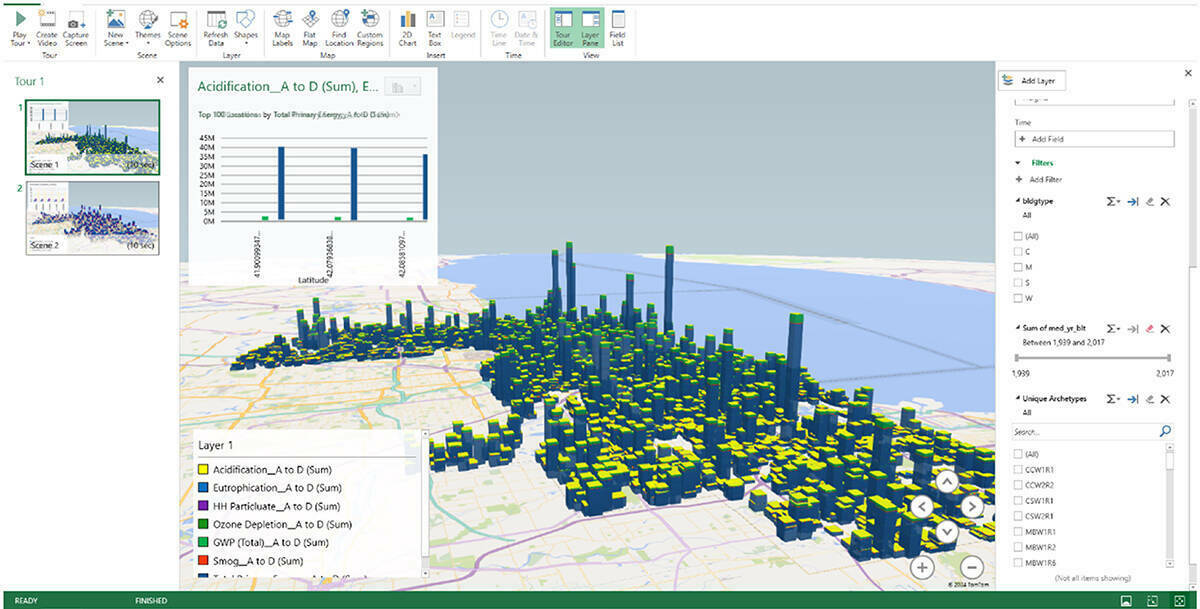
The impact of embodied carbon in the built environment has been difficult to assess, however, due to a lack of data. To address that knowledge gap, Hu and Siavash Ghorbany, a Notre Dame graduate student in civil and environmental engineering, have created a new way to analyze the embodied carbon in more than 1 million buildings in Chicago.
Their recently published research identifies 157 different architectural housing types in the city and provides the first ever visual analysis tool to evaluate embodied carbon at a granular level and to help inform policymakers seeking to strategically plan for urban carbon mitigation.
“Before, it was often difficult to visualize this concept and to make a case for why we want to preserve and reuse existing buildings,” Hu said. “We feel this is a more clear, direct way to help the policymaker or layperson make informed decisions. If I were the mayor of Chicago, I could look at this and say, ‘OK, before I tear down this building, I have to think twice because there’s already a lot of carbon embedded in this structure. Do I want to retrofit and reuse this building, or do I want to knock it down and build new, which will increase the overall embodied carbon?’”
Siavash Ghorbany
Hu and Ghorbany were able to identify emissions-intensive geographic zones and specific archetypes within the city — delivering actionable data to urban development stakeholders. They also found that increasing the average lifespan of buildings from the current 50 years to 75 years, and reducing their size by just 20 percent, can decrease their carbon emissions by two-thirds.
Hu emphasized that her research has found no scenario where tearing down an existing building to build something new — even if that new building is more energy efficient — makes sense, from an environmental perspective.
“If we look at the building’s entire lifespan, renovating the existing building has significantly lower carbon emissions over its whole life cycle, including operational and embodied carbon,” said Hu, who is also an affiliated faculty member in the College of Engineering. “That’s because the ‘payback period’ for constructing a new building is typically 20 years due to the high level of greenhouse gas emissions created by its construction. So, if we can extend a building’s life cycle to 70 or 80 years, then reusing the existing building definitely makes more sense.
“We should always reuse existing buildings. The real question is just to what extent we want to renovate and retrofit them.”
Hu and Ghorbany selected Chicago for a number of reasons, including its close proximity to Notre Dame, its architectural history — and because the city is ranked as the 8th highest for greenhouse gas emissions in the world. Going forward, they plan to scale up the project to evaluate embodied carbon in cities across the U.S.
The researchers, who received funding from the National Science Foundation, used machine learning and artificial intelligence to create an integrated dataset for their analysis, pulling from a variety of existing datasets, including the National Structure Inventory and Cook County Open Data for Chicago.
They matched the different types of data using their geolocation, then coded and categorized them based on different features, such as structural materials and roof type. From there, they multiplied the housing type’s baseline emissions by the footprint of each building to approximate its total embodied carbon.
Ghorbany, who is also a Graduate Scholar in the Lucy Family Institute for Data & Society and has an undergraduate degree in architecture, said that creating an accessible, interactive mapping tool to help visualize their findings was a top priority.
“Our goal for the end product was to create a user-friendly way to access and engage with this data,” he said. “We created this one so that you can try different scenarios by selecting which types of archetypes you want to see and filtering them by year or types of emissions. I hope that in the future, cities will be able to use this tool to reduce their carbon emissions so that we can help reduce climate change and the impacts we’re seeing from it.”
Hu agreed, and noted that the potential benefits of this research are not only environmental, but also cultural.
“First, it is crucial that we have a clear inventory of the embodied carbon in our built environment,” she said. “It’s something we’ve never had before and still don’t have nationwide. Once we have that, we can make informed decisions about how to reduce our carbon emissions, in part, by extending the lifespan of these buildings.
“And, in addition to the environmental benefits, there is social and cultural value to preserving these buildings that are part of the architectural character of the city.”
Contact: Carrie Gates, associate director of media relations, 574-993-9220, c.gates@nd.edu
Originally published by Carrie Gates at news.nd.edu on September 03, 2024.